
Reconstruct Chilton County Former Owners
A parcel works best as the starting point. Pull its current card and note the deed book, page, and date listed there. Every deed names two sides. The grantor conveys an interest, and the grantee receives it. Treat the current owner of record as a grantee first. The seller named in that deed is the next owner to chase back. Find that owner through an earlier deed. That chain keeps building the same way. Lay the legal description next to every parcel number and deed record you collect. Nothing gets mismatched that way.
| Transfer Date | Grantor → Grantee | Deed Type | Book / Page |
|---|---|---|---|
| Newest matching deed | Previous owner → current grantee | As indexed | Start from parcel card |
| Earlier matching deed | Earlier owner → previous grantee | As indexed | Copy from index |
| Older book entry | Prior grantor → prior grantee | As written | Vault book or film |
When a transfer is missing, check probate, spelling variants, or a changed legal description. Never insert an assumed owner.
Start With Chilton Deed References
The Chilton Public GIS property card shows the owner of record, parcel number, legal description, acreage, and subdivision. It also gives the deed book, page, and date of the last transfer. Parcel numbers in Chilton County begin with 14-. Split parcels carry decimal suffixes such as .000 or .001. Copy every digit. Those details keep land sharing a street name from getting tangled with an unrelated tract.
Older owners may hide under initials, historic street forms, or an addition name. The section-township-range, written S/T/R, often outlasts every address change the county has made. So does any plat or map book citation.
Reverse Chilton County Grantor Searches
The Chilton land-record portal lets a property search run by date range, book and page, grantor or grantee role, starts-with names, instrument type, and cross-reference. Images are available for a paid fee. The office does not publish its first online year or its current image price. Search the current owner as grantee first. Read the grantor named in that deed. Then run the grantor as a grantee in an earlier period. Open the official Chilton recording login to see the account entry point. The county uses it for online land-record access.
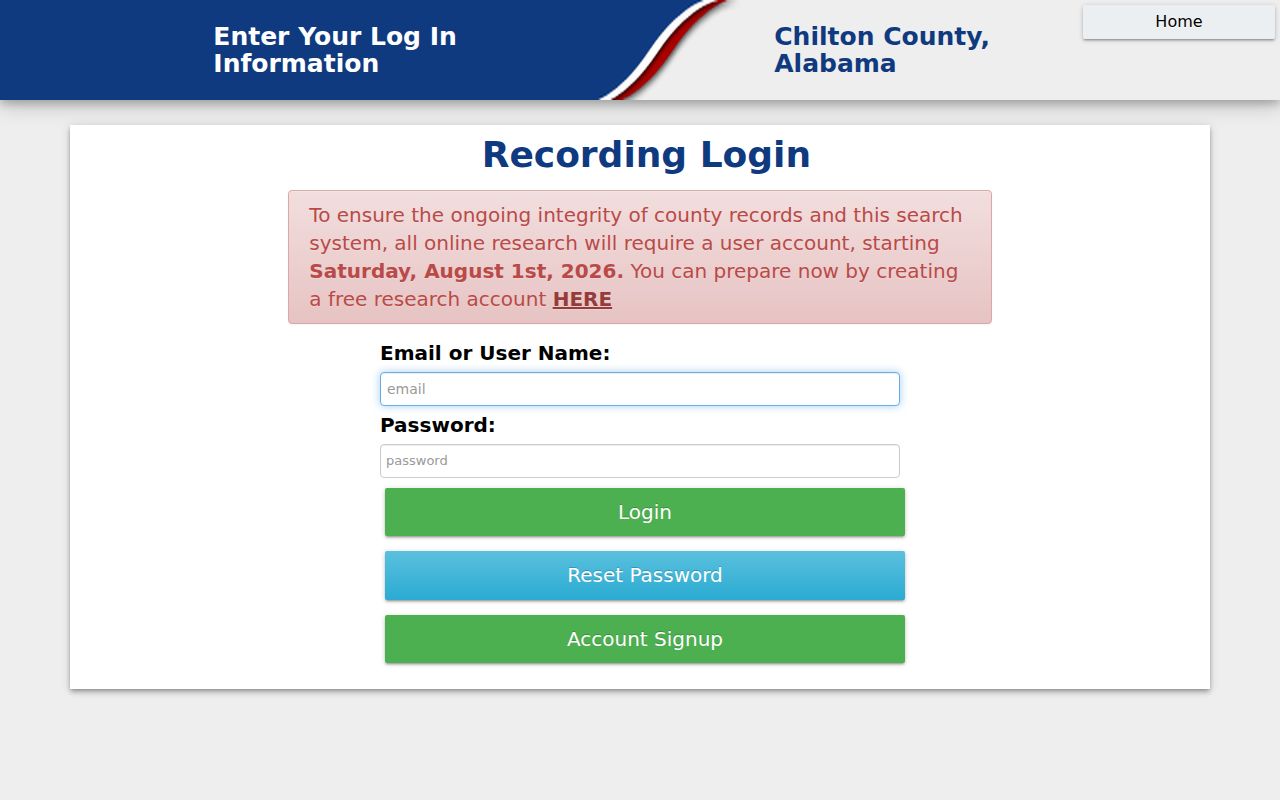
That login screen shows online document work requires an account. So the public vault stations matter whenever account or image access does not fit the job.
Coverage limit. Chilton County does not post the earliest online index year. Continue at a vault station and ask which deed book or microfilm series comes next.
Walk Chilton County Ownership Backward
Each backward step works best with two anchors. Use the party index and the land description together. A name match with no parcel match may belong to an entirely different family or tract.
- Copy the current card’s full deed reference and legal description.
- Find that deed and note the grantee, grantor, date, instrument, and book/page.
- Search the grantor as an earlier grantee and confirm that the same land passed.
- Repeat to the web cutoff, then carry the last citation into deed books or microfilm.
- Grantor and grantee
- The parties conveying and receiving an interest.
- Chain of title
- The linked sequence of recorded transfers.
- Reverse index
- The grantee-side index used to find how a seller acquired land.
- Quitclaim and warranty deed
- Different instruments that can each form a chain link.
- Legal description
- The land description that is more stable than an address.
A quitclaim deed still counts. Record what it says, then keep walking the chain from its parties and legal description.
Search Chilton County Vault Records
Four public-access stations sit in the Judge of Probate vault room. A fifth sits in the Tax Assessor's vault room. These terminals are the main fallback. They step in when the web index lacks an image, a year, or a detail. Bring the last book and page you found, name variants, the parcel number, the subdivision or S/T/R, and a date range. Probate records, judgments, liens, and leases often explain a link. Such a link can look strange in the deed chain alone.
For a formal request, county policy requires its standard form. It also requires proof of Alabama residency, in-person submission, and reasonable fees. Unsolicited electronic requests may go unanswered.
Follow Chilton Subdivision Changes
A chain can appear to dead-end the moment acreage was cut into lots. The description then changed to lot and block. The Historical Society Map Book 1 index holds 1897 Town of Clanton sheets. It also covers early additions. Other digitized books name Jemison Estates, Westlyn Hills, and Concordia Block. They list Simonton's Addition, High Forrest, and Woodland Hills too.
A map book never conveys title. It translates old tract, road, and addition labels into a plat citation. That citation leads back into the deed records.
Resolve Chilton County Estate Links
A death can move the record into an estate. An executor, personal representative, trustee, or heirs stand in the owner's place. Search the probate case records first. Then return to the executor or heir deed that carries the legal description. Alabama restricts death certificates for 25 years, yet that rule leaves open probate files and recorded deeds fully public. Estate researchers use this pairing often. They set a public probate transfer beside a later deed. They do not pretend a certificate and a land record answer the same question.
Extend Chilton Ownership Offline
The Alabama Department of Archives and History catalog lists county records on microfilm, maps, and newspapers. It also includes digital collections. Its request service works by form. Copy limits, fees, and roughly two to three weeks of processing apply. FamilySearch holds an Alabama wills and deeds collection reaching from about the 1700s through 2017. Chilton coverage varies inside that set. Confirm what the collection actually includes for this county.
Closer to home, the Chilton/Clanton Public Library provides Ancestry Library Edition, yearbooks, and local-history material. Old tax ledgers and city directories make good supporting clues. Treat them as context rather than a conveyance.
How Far Chilton Ownership Records Reach
Chilton County publishes no precise first year for its online deed index. Nor does it give one for its imaging cutover. Work online while the matches hold up. Then shift to the Probate stations and deed books, followed by microfilm and archival collections. County histories record no courthouse fire that destroyed land books. So assume no gap unless a source shows one.
Lawful use. Prior-owner research supports house history, estate work, and purchase diligence. Never use it to track, harass, intimidate, or harm a living person.
A thorough research log earns its keep. Record each name exactly as the index spells it. Add the role searched, date span, instrument type, book and page, and the legal-description match. Note the spellings that failed and where online coverage stopped. Write down what was checked. Leave any uncertain row open. For a single recorded instrument, copy options sit on the Chilton County deed records page.
Historic tax rolls and old directories can support a date range. Keep that evidence beside the deed chain, never inside it. Label each source and the fact it proves. Someone listed at an address may have occupied the land. They may also have paid the tax bill while holding no recorded title interest at all.
Subdivision work calls for maps. When a chain reaches a named plat, set the deed against the Historical Society's map-book finding aids. Chilton examples include the 1897 Town of Clanton sheets, Gowan Addition, Jemison Estates, and early Thorsby additions. A plat can preserve an old street, lot, block, easement, owner dedication, and recording page. Those details explain why a former legal description differs from the current address. Treat the index as a lead only. Rely on Probate for the recorded or certified plat.
An unresolved older link still deserves a clean record. Note the last proven grantee and the first proven grantor after the gap. That bounded span is a precise period. It also gives Probate staff, the archives, or a title professional a clear land description to examine.