
Inside Chilton Property Tax Records
Chilton County property tax records live in two places, and each answers a different question. The Revenue Commissioner holds the appraisal side. That office keeps the property record card, the parcel's owner of record, addresses, district, land and improvement values, total market value, exemption, yearly tax, and deed reference. The public GIS map pulls much of that together for a quick parcel search. Payment and tax bill details sit on the separate revenue site instead.
| Field | What It Shows | Where |
|---|---|---|
| Land and building value | Separate appraisal components | GIS property card |
| Appraised or market value | County estimate before ratio | Appraisal roll |
| Assessed value | Appraised value times class ratio | Assessment record |
| Exemption | Relief applied to the account | Assessor and GIS |
| Yearly tax and history | Annual charge and posted payments | GIS card and Revenue |
| Delinquency | Past-due or tax-sale status | Revenue and Alabama DOR |
Alabama builds assessed value in two moves. First the appraised or current-use value is set. Then it is multiplied by a classification ratio. Class III covers qualifying owner-occupied residential and agricultural property at 10 percent. So the assessed figure is not a sale price. Exemptions or a statutory cap can pull taxable assessed value down further after that calculation.
Chilton Tax-Year Search Fields
The official property search offers Tax Year, Search Type, Search Terms, Subdivision, and a Search control. The dropdown choices and historical depth vary by tax year, so pick the year before running a name or parcel. Public GIS runs alongside it with filters for owner, physical address, parcel range, district, subdivision, acreage, and value.
| Control | Use | Record to Save |
|---|---|---|
| Tax Year | Select the roll | Year searched |
| Search Type | Choose the lookup mode | Mode selected |
| Search Terms | Enter parcel or name clue | Exact query |
| Subdivision | Narrow a platted area | Indexed plat name |
Always tie a result to its year. Figures pulled from two different years can look like a trend that isn't there once classification, exemption, or parcel changes enter the picture.
Read Chilton Values in Order
Read the numbers in order. Land and improvement amounts come first. Then come total appraised or market value, class, true assessed value, taxable assessed value, exemption, and yearly tax. Each step answers a different question about the parcel. Act 2024-344 caps annual increases in taxable assessed value at 7 percent for qualifying Class II and Class III real property. Exclusions apply to some use or class changes. The cap protects one line, not the whole bill. Rates, exemptions, district treatment, and eligibility can all move the final amount. For the figures behind the bill rather than collection status, see the Chilton County property value record.
Note: Compare true assessed value with taxable assessed value before attributing a year-to-year difference to the seven-percent cap.
Chilton Exemptions and Assessment Timing
The Revenue Commissioner wears several hats. The office processes homestead and agricultural exemptions. It classifies property, appraises real and personal property, and maps land transactions from legal descriptions. After buying property, a purchaser must come to the Assessor's office to assess it no matter the intended use. Assessments filed by December 31 apply to the next tax year. That calendar can leave a freshly recorded deed running ahead of the roll. Before asking the office to correct anything, check the deed date, assessment year, owner field, exemption field, and physical address. Mailing-address changes also belong at the Assessor's office. And a mailing address alone never proves the owner lives on the parcel.
Findings that earn a section: the assessor portal's real search fields (render the table); the reassessment cycle and the appeal calendar with forms; the exemption list and how to apply; delinquent-tax lists and tax-sale records; the mill/levy breakdown; a recent revaluation news item. -->
Look Up a Chilton Tax Bill
The Revenue Commissioner's tax site is the official route for payment and taxpayer information. Start from the parcel number in GIS. A reused address or similar owner name can pull the wrong account otherwise.
- Open the parcel in Public GIS and copy the full parcel number and tax district.
- Select the correct tax year in the Revenue search and enter the parcel or supported search term.
- Compare the yearly tax and payment history with the exemption and value fields.
- Check delinquency through Revenue, then use the state transcript if the county list is unavailable.
- Call collections at 205-755-1249 when payment status or processor charges are unclear.
- Assessed value
- The appraised value after the Alabama class ratio.
- Taxable assessed value
- The base remaining after applicable relief or caps.
- Homestead exemption
- Qualified relief processed by the county Assessor.
- Tax lien
- A claim arising from unpaid property tax.
When Chilton Tax Becomes Delinquent
Alabama guidance sets property tax due on October 1 and delinquent after December 31. The county's online delinquent endpoint sometimes shows a notice that the delinquent list is unavailable. That message is not proof that no parcels are delinquent.
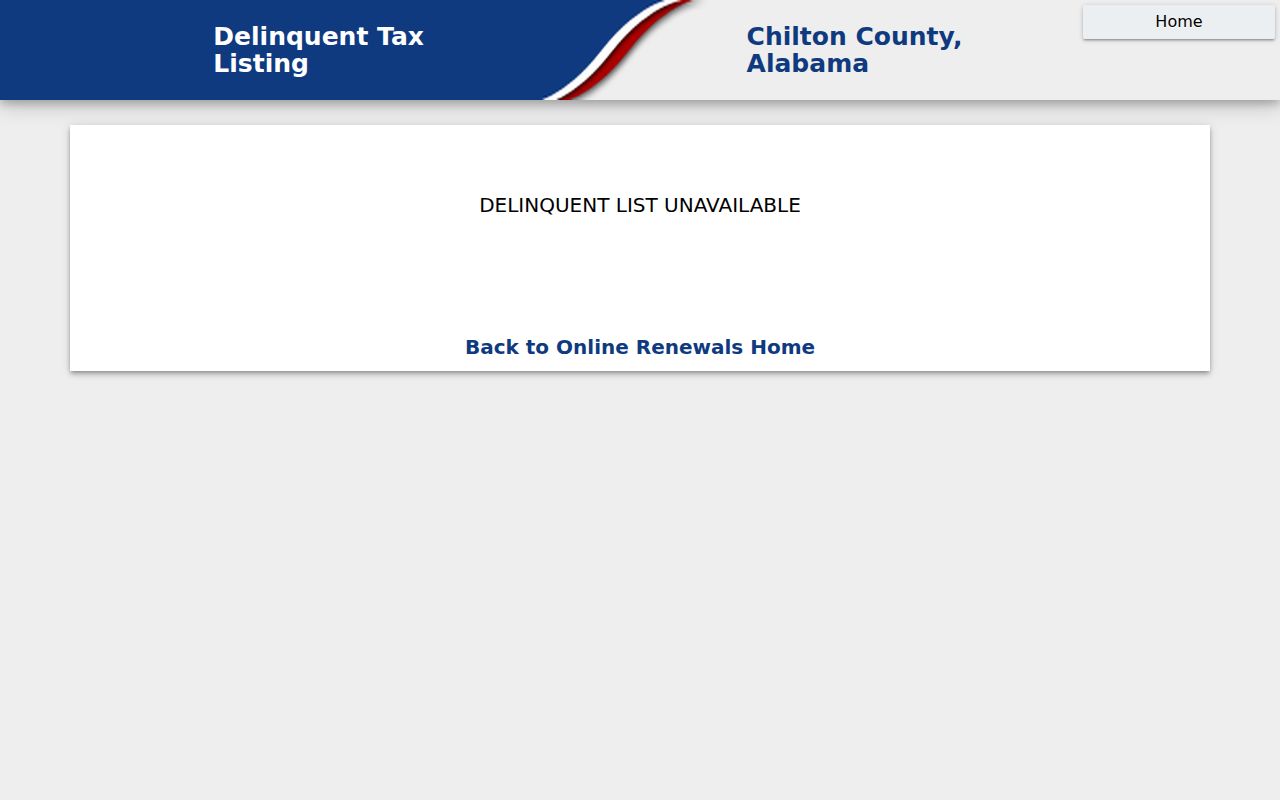
The notice makes a fallback source essential. Alabama DOR's Chilton transcript dated February 11, 2026 lists delinquent land available for sale with name, year, class or code, parcel ID, legal description, bid amount, and assessed value. Confirm current status with Revenue before acting on any entry. A payment, redemption, or other event can follow a published transcript at any point.
Chilton Payment History on GIS
The official property record card pairs Yearly Tax with a tax-history table. The table shows year, date, and amount. Around it sit the parcel number, owner and mailing address, physical address, acreage, deed book, page, and date. Values, legal description, and building facts appear there too. That layout helps separate a payment entry from the appraisal that produced the bill. A sample Chilton property record card shows the combined view.
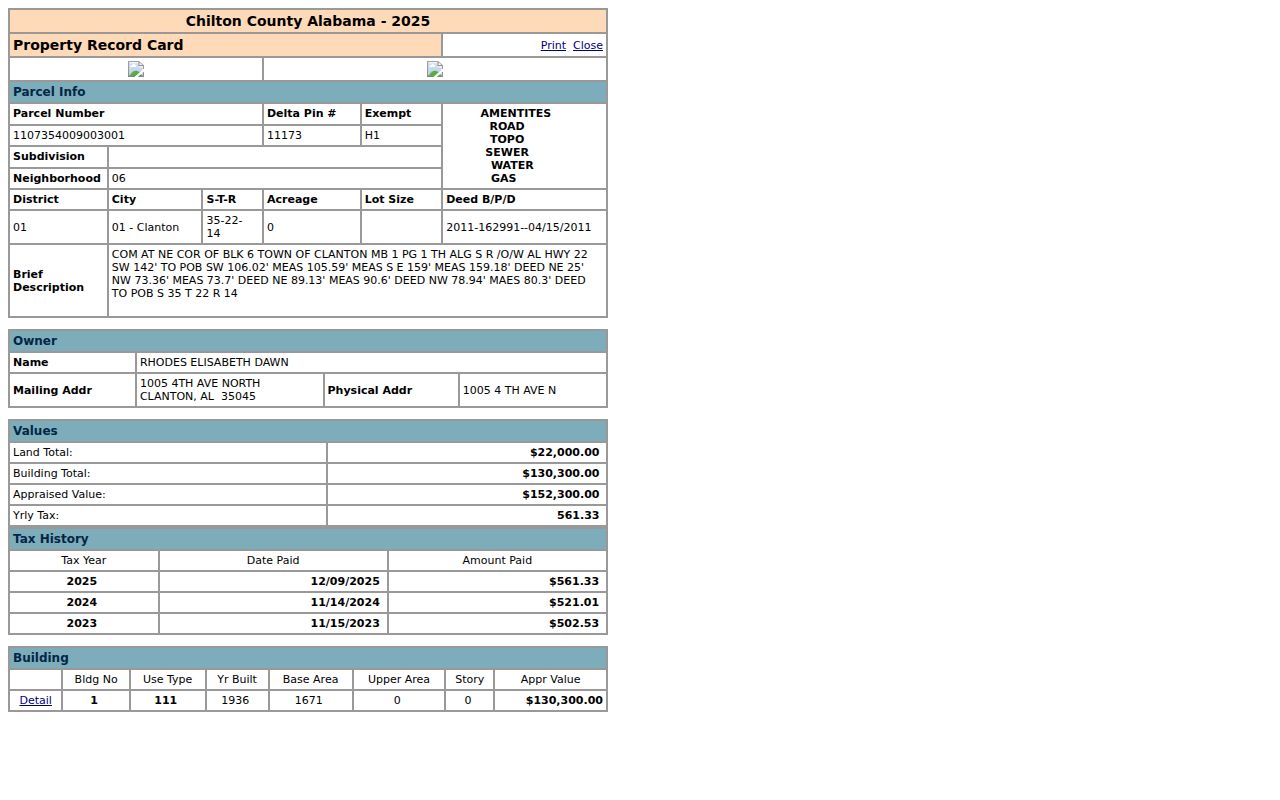
This is why a tax-history row should be saved with its parcel, tax year, and value fields. Copied alone, the row loses the context that makes it mean something.
Offline Chilton Tax Access
Online access is only one channel. Revenue lists collections at 205-755-1249, assessments and exemptions at 205-755-0155, appraisal at 205-755-0160, and mapping at 205-755-2356. Counter staff can clarify an exemption, an ownership lag, a parcel split, or a payment entry. Historical tax ledgers also sit with the Chilton County Historical Society, and Alabama Archives and History offers county microfilm plus research requests. For a Commission public-record request outside the normal tax-account route, Chilton County requires its standard form, proof of Alabama residency, and in-person delivery under its current Act 2024-278 procedure. Fees may be required in advance, and unsolicited electronic submissions may go unacknowledged.
Protest a Chilton Assessment
Alabama DOR gives an owner 30 days after written notice of valuation to file a written protest with the county Board of Equalization. The protest rests on Code sections 40-3-20, 40-3-24, and 40-3-25. Mark the notice date the day it arrives. A general state assessment appeal page will not substitute for the county protest. File locally.
Evidence works best when it ties to the parcel and the valuation date. Bring the property record card, photographs of condition, a survey or plat when land area is disputed. Bring exemption documents, and records of factual errors in the building or land data. The appraisal and assessment staff can explain the current filing steps.
Appeal window. File a written Chilton County Board of Equalization protest within 30 days after the written valuation notice.
Keep the valuation itself separate from the final bill. The board protest addresses the assessment only. Payment, delinquency, tax-sale status, and redemption questions belong with collections. Alternatively, take them to whatever authority is named on the record.
A complete Chilton County property tax packet keeps the written valuation notice. It should also hold the envelope or delivery date, the current property card, the prior-year card, a parcel map, the legal description, the exemption status, and any evidence of a factual error. Name the exact value field being challenged. Land value, improvement value, appraised value, true assessed value, and taxable assessed value are not synonyms. A protest that blurs them invites confusion.
Dates matter after a sale. Compare the deed date against the assessment year and the purchaser's December 31 assessment duty. After a split, save every parent and child parcel number, decimal suffixes included. For land area or improvements, rely on dated records identifying the same parcel. Nearby sale prices make a broad argument. But a wrong acreage, building fact, class, or exemption entry needs a specific correction.
Tax-sale research runs on dates too. The state transcript serves as an official fallback when the county delinquent page is unavailable. Still, it captures only one point in time. Ask Revenue whether the tax was later paid, whether a sale occurred, and which redemption record applies. Probate may hold a later tax, redemption, or conveyance instrument. Never infer current ownership from one delinquent list row.
The Board of Equalization route stays separate from a general Commission request under the Open Records Act. A protest follows the valuation notice and current county filing instructions. Use the county's standard public-records procedure only for a qualifying Commission record. That record must sit outside the ordinary assessment, collection, or board process.