
Compare Chilton County Value Types
One Chilton County card can hold several figures at once. Assessment, taxation, and a past sale each answer a different question. Read the label and the year first, then ask which office produced the number before comparing anything.
| Value | What It Is | Where |
|---|---|---|
| Appraised or market value | County mass-appraisal estimate of full value | Revenue Commissioner parcel card |
| Assessed value | Appraised value multiplied by the class ratio | Assessment record |
| Taxable assessed value | Figure after applicable exemption or cap effects | Tax and assessment record |
| Last sale or consideration | Amount or transfer clue tied to a deed, when shown | Recorded deed or transfer record |
Residential and agricultural property in Chilton County falls under Alabama's Class III designation. That class carries a 10 percent assessment ratio. A $100,000 appraised value therefore produces a $10,000 assessed value before the tax bill is calculated. It also comes before any exemption is applied. That gap between the two numbers is built into state law. It is not a clerical error, and comparing a Chilton County appraisal against the wrong column can make an otherwise correct record look mistaken.
Read Four Chilton Card Numbers
The Chilton Public GIS property card displays land and improvement components. Market and assessed figures appear alongside them. Acreage, deed B/P/D, annual tax, and exemptions appear there too. Tax history, building data, and the legal description round out the card. Land value reflects the site itself. Improvement value covers buildings and other appraised additions. Together they explain the combined appraised figure on the parcel record. Open the official parcel-card source to see the numbers. Any Chilton County parcel you are researching is covered there.
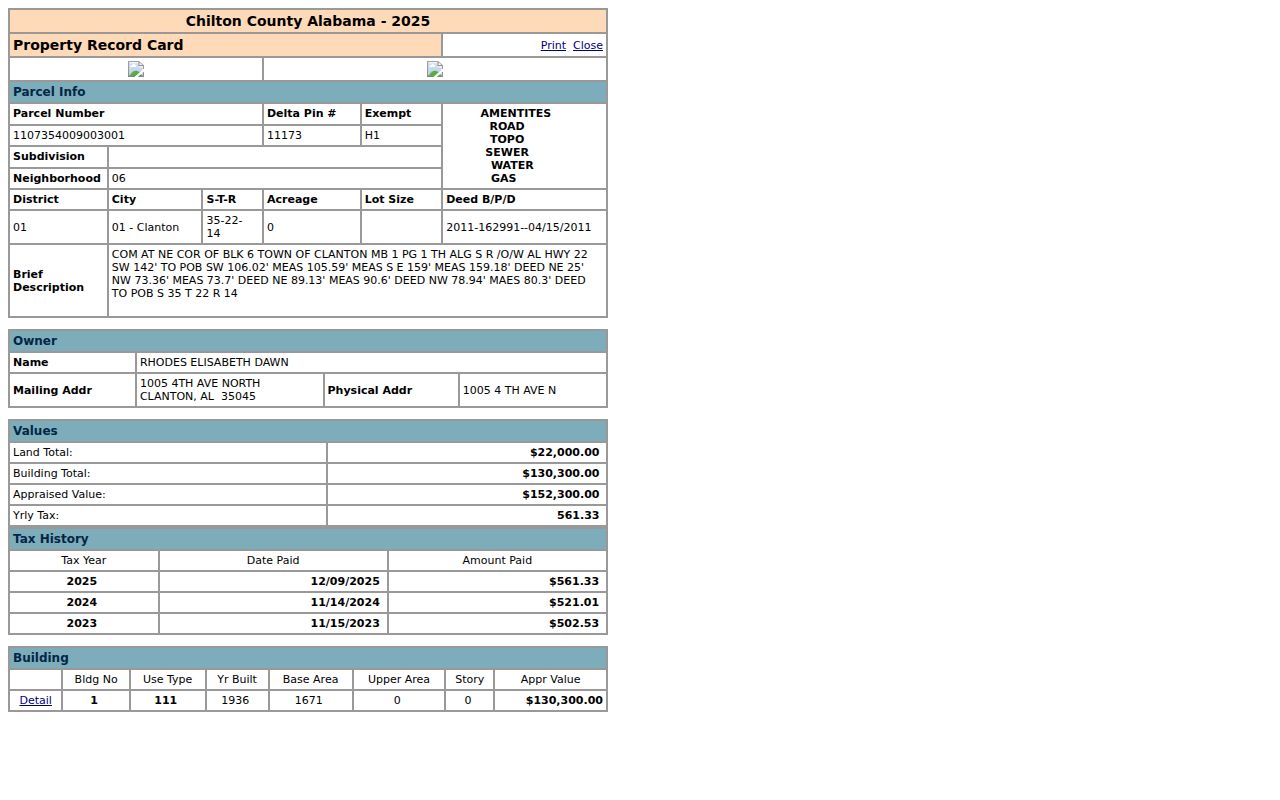
The layout keeps value fields beside parcel and deed clues.
That placement helps you compare the right tract and year on a Chilton County card.
Apply Chilton Class III Ratios
The Alabama Department of Revenue assessment guidance spells out property classes and the assessment formula. Class III covers residential, agricultural, forest, and historic property. It generally carries a 10 percent ratio. Other classes use different statutory ratios. Confirm the class before applying 10 percent to every parcel. The ratio is simply the share of appraised value that becomes assessed value. It is not a discount off a potential sale price.
Look Up Chilton County Values
Chilton County's property records tools make a value lookup straightforward and repeatable. Write down the tax year and the full parcel number before you close the page. Doing so keeps a later property search pinned to the same tract, the same appraisal, and the same assessment period every time.
- Search the Revenue property portal by its available tax year, search type, search terms, and subdivision controls.
- Confirm the matching parcel in Public GIS by physical address, owner, parcel ID, acreage, district, or subdivision.
- Read the land, improvement, market or appraised, assessed, exemption, and annual-tax fields with their year.
- Check the deed reference for a recorded transfer clue, while treating any sale amount as a past event rather than a current appraisal.
- Assessed value
- The appraised figure multiplied by the statutory class ratio.
- Market or appraised value
- The county’s mass-appraisal estimate of full value.
- Assessment ratio
- The class percentage used to derive assessed value.
- Consideration
- An amount or value stated in connection with a deed transfer.
- Reassessment
- The official process that updates an assessment for a new period.
Separate Chilton Land and Buildings
The card's land and improvement lines show how the county divides its appraisal. Vacant acreage may show little or no improvement component. A developed parcel may shift because of building data, land treatment, or both. Compare the separate lines before assuming one year's change came from the whole property. Parcel changes matter too. Chilton IDs visibly start with 14-, and split tracts may carry .000 or .001 suffixes. A new suffix can appear. It can mean an older value belongs to a parent parcel rather than the present lot.
Understand Chilton Taxable Assessment
An exemption affects taxable treatment. It does not create a market estimate. Alabama's current Act 2024-344 guidance explains a seven-percent cap on qualifying Class II and Class III taxable assessed-value increases. The same guidance separates true assessed value from taxable assessed value.
That distinction matters in any year-over-year comparison. A capped taxable figure may rise differently from the underlying appraised or true assessed amount. The cap is not a limit on what a buyer might pay.
Compare Chilton Sale Records Carefully
A deed's consideration or a reported last-sale amount reflects one transaction. Circumstances behind it may not be visible from the amount alone. The Probate index supports book/page, date-range, grantor/grantee, instrument, and cross-reference searching, though the current image fee and earliest online year are not publicly posted. Treat a recorded sale as a dated reference. Do not call it a current comparable-sales appraisal just because it sits beside a parcel. Payment history and annual tax are not measures of market value either.
Check Chilton Value Access Channels
Online options include the Revenue property search and Public GIS reports. If those fall short, the Revenue Commissioner handles appraisal, exemptions, mapping, and assessment questions. One public-access station sits in the Tax Assessor vault. Four Probate vault stations support deed follow-up. Confirm the counter location before visiting. County pages now list 53 Robert Threlkeld Parkway for many offices, while older state listings still show 500 Second Avenue North. A formal unposted-record request uses the county's standard form. It requires Alabama-residency proof, in-person submission, and reasonable fees. Electronic requests sent outside that process may not receive acknowledgment.
Limits of Chilton Property Values
An assessor's property value is a mass-appraisal figure used in the public tax system. It is not a site-specific appraisal for a sale, and it settles no question of condition, title, boundary, or future price. A GIS parcel line is not a survey either.
Value versus price. Chilton County assessed value supports taxation and is not what the property will necessarily sell for. Obtain a qualified appraisal when current market value controls.
Exemptions, tax-bill math, and protest deadlines are covered on the Chilton County property tax records page. A value comparison should stay focused on the numbers themselves. Record the parcel number, tax year, and property class for each year you compare. Add the land value, improvement value, appraised value, and true assessed value. Then add the taxable assessed value, any exemption, and the deed date. Comparing the same labeled field across years is far safer than mixing labels. Never set one year's market line against another year's taxable line. The labels keep you honest.
Before crediting the market with a jump in value, rule out changes in the record itself. A parcel split can move one field while leaving the others still. So can a new building entry, corrected acreage, or a class change. A capped taxable calculation can do the same. The property record card and its year supply that context. Building details on the county card can explain an improvement-value shift too. Copy the building use, year built, base area, upper area, and report year exactly as shown. The card does not state the inspection date or valuation model behind each entry. If something looks wrong, ask appraisal staff about a correction instead of assuming an undocumented renovation.
A tax-sale transcript also deserves care. It carries an assessed value for its own stated year and process, not a present market estimate. Match its parcel ID and legal description to the current card. Keep the transcript date beside the amount. That way a distressed-property record is never mixed with a later appraisal. When a displayed figure seems off, bring the parcel number, tax year, and field label to Revenue appraisal or assessment staff. A public-records request can retrieve an existing record. But it cannot replace the county's correction or assessment-review procedure.